

Manufacturers are under constant pressure to improve cleanliness, reduce downtime, minimize chemical consumption, and maintain increasingly demanding quality standards. As a result, industrial cleaning technologies have evolved significantly over the past two decades.
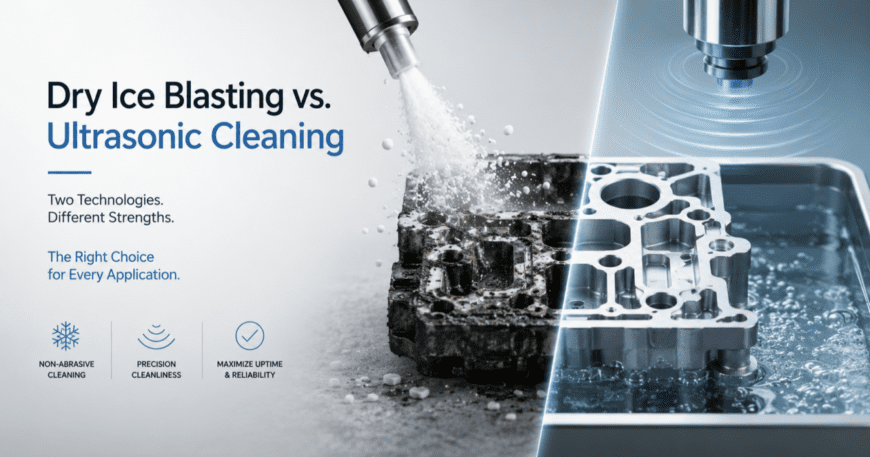
Among the many options available today, dry ice blasting and ultrasonic cleaning are frequently discussed as potential solutions for contamination removal. While both technologies are effective, they address fundamentally different cleaning challenges.
The question is not which technology is better.
The more important question is where each technology delivers the greatest value.
Understanding the strengths and limitations of both approaches can help manufacturers avoid costly investment mistakes and select the most appropriate cleaning process for their application.
Understanding Dry Ice Blasting
Dry ice blasting uses compressed air to accelerate solid carbon dioxide pellets toward a contaminated surface. Upon impact, the pellets transfer kinetic energy, create localized thermal shock, and rapidly sublimate from solid to gas.
This combination helps remove contaminants from the surface without generating secondary blasting media waste.
Unlike sandblasting or abrasive blasting methods, dry ice pellets disappear after impact, leaving only the removed contamination to be collected.
The technology has gained popularity in industries where cleaning must be performed directly on installed equipment, production machinery, molds, conveyors, and electrical systems.
Common applications include:
- Injection molding equipment
- Food processing machinery
- Printing equipment
- Packaging lines
- Welding fixtures
- Electrical panels
- Production tooling
- Paint booth maintenance
One of its greatest advantages is the ability to clean equipment without extensive disassembly.
Understanding Ultrasonic Cleaning
Ultrasonic cleaning operates on a completely different principle.
High-frequency sound waves are introduced into a liquid cleaning medium. These sound waves generate microscopic cavitation bubbles that continuously form and collapse throughout the liquid.
The collapse of these bubbles produces localized energy capable of dislodging contaminants from component surfaces.
Because cavitation occurs throughout the cleaning solution, ultrasonic cleaning can reach areas that are inaccessible to conventional cleaning methods.
This makes the technology particularly effective for components containing:
- Blind holes
- Internal passages
- Fine threads
- Complex geometries
- Deep cavities
- Precision machined features
Applications commonly include:
- Automotive components
- Aerospace parts
- Medical instruments
- Precision machined components
- Hydraulic systems
- Electronic assemblies
- Bearings
- Valves
Ultrasonic cleaning is often used when contamination must be removed not only from visible surfaces but also from difficult-to-access internal features.
The Critical Difference: Surface Cleaning vs Precision Cleaning
The most important distinction between the two technologies lies in the type of contamination being addressed.
Dry ice blasting is primarily a surface-cleaning technology.
It excels at removing:
- Grease
- Carbon deposits
- Paint residues
- Mold-release agents
- Production buildup
- Surface contamination
Ultrasonic cleaning is primarily a precision-cleaning technology.
It is particularly effective for removing:
- Fine particulate contamination
- Machining chips
- Grinding residues
- Polishing compounds
- Oil films
- Residues trapped in internal features
This distinction becomes increasingly important as component complexity increases.
A dry ice stream may effectively clean the exterior of a hydraulic manifold. However, contaminants trapped inside drilled passages, intersecting channels, and threaded ports may remain unaffected.
Ultrasonic cavitation, by contrast, can penetrate these internal geometries and remove contamination throughout the component.
Downtime Considerations
Maintenance teams often evaluate cleaning technologies based on production downtime.
In this area, dry ice blasting offers a significant advantage.
Many cleaning tasks can be performed directly on installed equipment without extensive dismantling. Production assets can often be returned to service immediately after cleaning.
For production environments where uptime is the primary concern, this capability can be extremely valuable.
Ultrasonic cleaning typically requires components to be removed and placed into a cleaning system. Depending on the application, additional rinsing and drying stages may also be required.
While this increases process time, it often delivers a much higher level of cleanliness than surface cleaning alone.
The tradeoff is straightforward: dry ice blasting minimizes downtime, while ultrasonic cleaning maximizes cleanliness.
Environmental and Safety Considerations
Both technologies are frequently promoted as environmentally responsible alternatives to traditional solvent-based cleaning methods.
Dry ice blasting generates no secondary blasting media waste because the carbon dioxide pellets convert directly into gas after impact. However, adequate ventilation is essential to prevent carbon dioxide accumulation in enclosed areas.
Ultrasonic cleaning systems can significantly reduce manual cleaning effort and solvent consumption. Modern systems increasingly use aqueous cleaning chemistries, filtration systems, and process controls to improve sustainability.
Environmental performance ultimately depends on the specific cleaning chemistry, contamination type, water treatment strategy, and operational practices employed by the facility.
Where Dry Ice Blasting Performs Best
Dry ice blasting is often the preferred choice when manufacturers need to:
- Clean installed equipment
- Remove heavy surface contamination
- Reduce maintenance downtime
- Avoid equipment disassembly
- Clean electrical systems safely
- Maintain production continuity
Industries commonly using dry ice blasting include food processing, plastics manufacturing, packaging, printing, and general industrial maintenance.
Where Ultrasonic Cleaning Performs Best
Ultrasonic cleaning is typically preferred when manufacturers need to:
- Achieve precision cleanliness requirements
- Remove microscopic contamination
- Clean complex geometries
- Meet cleanliness specifications
- Prepare surfaces for coating or plating
- Improve assembly reliability
- Remove contamination from internal passages
Industries commonly using ultrasonic cleaning include automotive, aerospace, medical devices, electronics, precision engineering, and surface treatment operations.
The Future Is Process-Specific Cleaning
As manufacturing quality standards continue to rise, cleaning technologies are becoming increasingly specialized.
Rather than replacing one another, dry ice blasting and ultrasonic cleaning are often used for entirely different objectives within the same facility.
A manufacturer may use dry ice blasting to maintain production equipment and molds while relying on ultrasonic cleaning to prepare precision components for assembly, coating, or final inspection.
The most effective cleaning strategy is rarely determined by the technology itself. It is determined by the contamination being removed, the cleanliness level required, the geometry of the component, and the operational constraints of the manufacturing process.
Organizations that begin with those factors are far more likely to select the right cleaning solution than those searching for a universal answer.
Stay Informed
Manufacturing technologies continue to evolve as cleanliness standards, quality expectations, and process requirements become more demanding.
Subscribe to the Ralsonics Research Pvt. Ltd. and Kunal Parikh Insights newsletter for technical articles, industry analysis, manufacturing trends, contamination-control strategies, surface treatment developments, and practical guidance for engineering and operations professionals.
