
Here Is What That Means For Your Production Line
The India-South Korea $50 billion trade commitment is an opportunity. Capturing it requires understanding what Korean supply chains actually demand.
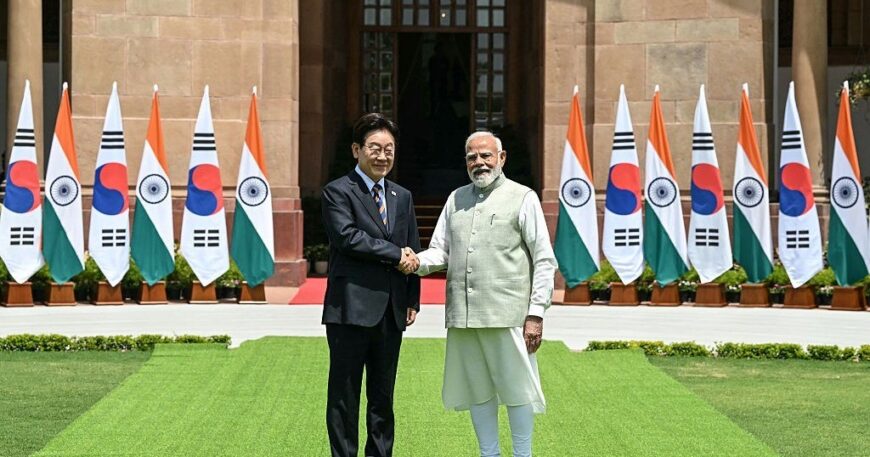
Yesterday, Prime Minister Modi and South Korean President Lee Jae Myung signed 25 agreements in New Delhi. Bilateral trade target of $50 billion by 2030. Industrial cooperation committees. A Korean industrial township on Indian soil. Frameworks across semiconductors, shipbuilding, steel and supply chains.
The scale of what was signed yesterday goes beyond a trade target. The two governments established a new ministerial-level Industrial Cooperation Committee to meet annually and resolve investment and trade barriers in real time.
POSCO and JSW signed an MoU to build a 6 million tonne integrated steel plant in Odisha; a project valued at over $1 billion. India and South Korea also launched an India-Korea Digital Bridge, a financial forum to facilitate capital flows, and agreed to resume CEPA upgrade negotiations that have been stalled for years.
On the manufacturing side, cooperation was confirmed across semiconductors, shipbuilding, green steel, critical minerals and defence, with a South Korea-India defence accelerator announced specifically to support defence startups. Samsung, Hyundai and LG executives were part of the delegation, signalling that this is not just a government conversation. The business pipelines are already forming.
The headlines are about diplomacy. The opportunity is in the details.
South Korea is not just a large trading partner. It is home to Samsung, Hyundai, POSCO and LG, companies that operate some of the most quality-disciplined manufacturing supply chains on earth. Korean manufacturing culture has a word for it: poka-yoke thinking applied at every stage, not just assembly. Zero defect is not an aspiration there. It is an operating standard.
When Indian manufacturers enter Korean supply chains, or compete to supply Korean-anchored industrial projects on Indian soil, they are not being benchmarked against Indian quality norms. They are being benchmarked against Korean ones.
That gap is where the real work begins.
What Korean supply chains look at that most Indian audits don’t
Korean industrial procurement is methodical in ways that catch Indian suppliers off guard. Beyond dimensional tolerances and material certifications, Korean OEM audits look closely at process consistency, the ability to demonstrate that every component in a batch was produced under identical, documented, controlled conditions.
Surface cleanliness is one of the most scrutinised process steps in this context. A component destined for a Samsung electronics assembly, a Hyundai powertrain, or a POSCO steel processing line carries cleanliness specifications that are defined in microns and milligrams, not in visual inspection or operator judgement.
Residual machining oils, ionic contamination from cutting fluids, metallic particulate in blind holes, these are the failure points that Korean audits find and Indian facilities often don’t catch until they do.
The industrial township changes the timeline
One of yesterday’s announcements was a Korea-specific industrial township in India to ease market entry for Korean SMEs. This is significant for Indian component manufacturers because it compresses the qualification timeline considerably.
Korean companies setting up operations in India will need local suppliers. They will qualify those suppliers against Korean standards. The Indian manufacturers already operating at that standard when the township becomes active will be inside those supply chains from day one. The ones who upgrade after the fact will be chasing a door that is already closing.
The window between announcement and operation is where preparation happens.
What preparation looks like
For precision cleaning and surface engineering, one of the most consistently scrutinised process stages in Korean supplier audits, preparation means building validated, documented, repeatable cleaning infrastructure before the audit, not in response to it.
Multistage ultrasonic cleaning systems with IoT process monitoring. Defined cleanliness specifications per component type. Batch-level traceability records. These are not complicated requirements. They are the baseline that Korean supply chain entry demands.
Ralsonics works with Indian manufacturers at exactly this stage; building the cleaning and surface engineering infrastructure that global supply chain qualification requires. If your facility is targeting Korean-partnered supply chains, semiconductor projects, shipbuilding components or steel processing applications, the qualification process starts with your production infrastructure.
Contact Ralsonics for a process audit, system consultation or customised quote. The $50 billion opportunity was announced yesterday. The manufacturers who capture it start preparing today.

