

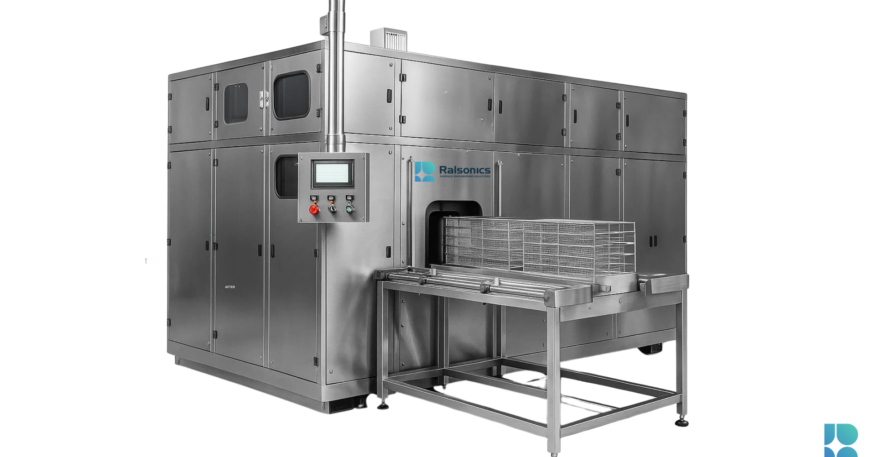
Industrial components operate in harsh environments, exposed to oil, grease, carbon deposits, rust, metal fines, and chemical residues. Over time, these contaminants compromise performance, reduce product quality, and lead to costly rework or failures. Conventional cleaning methods like manual scrubbing, spray washing, or chemical soaking often fail to clean complex geometries thoroughly.
This is where industrial ultrasonic cleaners become essential.
By using high-frequency sound waves in a liquid medium, ultrasonic cleaning removes stubborn contaminants from even the most intricate and inaccessible areas, without damaging the part. Let’s explore when industrial ultrasonic cleaners should be used and the real-world problems they solve.
What Is Industrial Ultrasonic Cleaning?
Industrial ultrasonic cleaning uses high-frequency ultrasonic waves (typically 20–80 kHz) transmitted through a cleaning solution.
This controlled cavitation:
- Loosens bonded contaminants
- Penetrates blind holes, crevices, and internal channels
- Cleans uniformly across complex surfaces
The result is deep, non-destructive, and repeatable precision cleaning.
When Should You Use an Industrial Ultrasonic Cleaner?
Industrial ultrasonic cleaners are not just an upgrade, they are a necessity when traditional cleaning fails to deliver consistency, quality, or compliance.
1. When Oil & Grease Are Deeply Entrenched
The problem:
Machining oils, cutting fluids, lubricants, and hydraulic grease cling to metal surfaces and seep into threads, grooves, and cavities. Manual or spray cleaning often leaves behind invisible residues that affect coating adhesion, assembly accuracy, and product reliability.
Ultrasonic solution:
Cavitation penetrates deep into microscopic surface irregularities, emulsifying and lifting oil and grease without aggressive chemicals.
Industries impacted:
- Automotive & auto components
- Aerospace machining
- Heavy engineering
- Hydraulic & pneumatic systems
2. When Carbon Deposits Are Tough and Baked-On
The problem:
Carbonized residues form due to high temperatures in engines, heat treatment, furnaces, and combustion systems. These deposits are extremely hard, uneven, and resistant to conventional cleaning.
Ultrasonic solution:
High-energy cavitation breaks the bond between carbon layers and the substrate, cleaning without abrasion or surface damage.
Common applications:
- Engine components
- Injectors & nozzles
- Heat exchangers
- Furnace parts and tooling
3. When Rust and Oxidation Affect Precision Parts
The problem:
Moisture, storage conditions, and exposure to air cause rust, oxidation, and surface discoloration. Mechanical removal methods can damage tolerances or alter surface finish.
Ultrasonic solution:
Ultrasonic cleaning combined with rust-removal or passivation chemistry removes oxidation uniformly while preserving dimensional accuracy.
Best suited for:
- Precision machined parts
- Bearings and gears
- Medical instruments
- Aerospace components
4. When Parts Have Complex Geometry
The problem:
Components with blind holes, internal channels, micro-features, threads, and undercuts are impossible to clean manually or with spray washers.
Ultrasonic solution:
Cavitation occurs everywhere the liquid reaches, ensuring 100% surface contact, even in internal passages and inaccessible areas.
Critical applications:
- Fuel injectors
- Valves and manifolds
- Medical implants
- Aerospace assemblies
- 3D-printed metal parts
5. When High Cleanliness Standards Are Mandatory
The problem:
Industries like aerospace, medical, electronics, and pharmaceuticals demand contamination-free components. Even microscopic residues can cause failures, rejections, or regulatory non-compliance.
Ultrasonic solution:
Industrial ultrasonic cleaners deliver repeatable, validated, and documented cleanliness levels, making them ideal for critical industries.
Compliance-driven sectors:
- Aerospace & defence
- Medical devices
- Semiconductor & electronics
- Pharmaceuticals
6. When Manual Cleaning Is Slow, Costly, and Inconsistent
The problem:
Manual cleaning increases labor costs, introduces human error, and lacks repeatability. Production bottlenecks and inconsistent quality become common.
Ultrasonic solution:
Automated ultrasonic cleaning systems reduce cycle time, minimize labor dependency, and ensure consistent cleaning across batches.
Key benefits:
- Higher throughput
- Reduced rework and scrap
- Lower chemical and water consumption
Contaminants Industrial Ultrasonic Cleaners Effectively Remove
| Contaminant Type | How Ultrasonics Solve It |
| Oil & grease | Emulsifies and lifts residues from micro-surfaces |
| Carbon deposits | Breaks bonded layers without abrasion |
| Rust & oxidation | Uniform removal with controlled chemistry |
| Metal chips & fines | Dislodges trapped particles |
| Polishing compounds | Cleans residues from pores and crevices |
| Chemical residues | Complete rinsing and surface activation |
Key Advantages Over Conventional Cleaning Methods
- Non-abrasive and non-destructive
- Cleans complex and internal geometries
- Reduces chemical usage
- Improves downstream processes (coating, bonding, assembly)
- Consistent, repeatable, and automatable
Industries That Rely on Industrial Ultrasonic Cleaning
- Automotive & EV manufacturing
- Aerospace & defence
- Medical device manufacturing
- Precision engineering
- Electronics & semiconductors
- Oil & gas
- Tooling & die manufacturing
Final Thoughts: Is an Industrial Ultrasonic Cleaner Right for You?
If your cleaning challenges include:
- Persistent oil, grease, carbon, or rust
- Complex part geometries
- High cleanliness or regulatory requirements
- Inconsistent manual or spray cleaning results
FAQ
Industrial ultrasonic cleaners effectively remove oil, grease, carbon deposits, rust, oxidation, polishing compounds, metal fines, dust, and chemical residues. They are especially effective for contaminants trapped in blind holes, threads, micro-features, and internal channels.
Yes. Ultrasonic cavitation penetrates microscopic surface irregularities and emulsifies heavy oils and greases, even from precision-machined and tightly assembled components, without damaging the part.
Yes. Industrial systems can be fully automated and integrated with material handling, filtration, rinsing, drying, and PLC controls, making them ideal for high-throughput and continuous production environments.
No, when correctly configured. Ultrasonic cleaning is non-abrasive. By selecting the right frequency, power density, cycle time, and chemistry, even delicate, tight-tolerance, and high-value components can be cleaned safely.

