

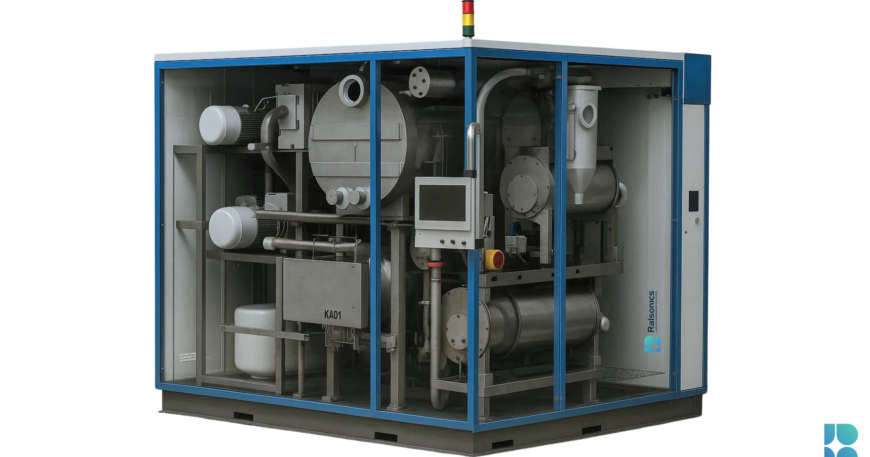
In high-precision manufacturing, cleaning is not just about removing visible dirt, it’s about eliminating microscopic oils, greases, and residues that can compromise performance, safety, and compliance. While aqueous ultrasonic cleaning systems dominate many industrial applications, vapor degreasers remain the gold standard for precision degreasing where speed, dryness, and zero residue are critical.
This blog explores what vapor degreasing is, where it excels, its advantages, and when it should be chosen over aqueous cleaning systems.
What Is Vapor Degreasing?
Vapor degreasing is a solvent-based precision cleaning process that uses heated solvent vapors to remove oils, greases, waxes, and contaminants from metal and precision components.
How It Works:
- Solvent is heated to its boiling point inside a sealed chamber
- Solvent vapors rise and condense on cooler parts
- Condensed solvent dissolves and washes away contaminants
- Clean solvent drips back into the sump
- Parts exit spotlessly clean and completely dry
Unlike water-based cleaning, no rinsing or drying stage is required.
Key Applications of Vapor Degreasers
Vapor degreasing is ideal for complex, precision, and contamination-sensitive components.
1. Precision Metal Parts Cleaning
- CNC-machined components
- Bearings, gears, shafts
- Hydraulic & pneumatic components
- Aerospace fasteners
Removes cutting oils, machining fluids, and preservatives
Penetrates blind holes and capillaries
2. Aerospace & Defence Components
- Turbine parts
- Fuel system components
- Avionics housings
- High-tolerance assemblies
Meets strict aerospace cleanliness standards
Leaves no moisture or ionic residue
3. Automotive & EV Manufacturing
- Engine components
- Fuel injection systems
- Transmission parts
- EV motor housings & connectors
Rapid degreasing before assembly
Ensures adhesion before coating or bonding
4. Electronics & Electrical Components
- PCBs & electronic assemblies
- Connectors & relays
- Sensors & control units
Safe for moisture-sensitive components
Eliminates flux residues and oils without corrosion risk
5. Medical Devices & Surgical Instruments
- Orthopedic implants
- Surgical tools
- Stainless steel & titanium components
High cleanliness for regulatory compliance
Supports validated cleaning processes
6. Optical & Precision Instruments
- Lenses & optical mounts
- Measuring instruments
- Precision tools
No spotting or water marks
Maintains surface integrity
Not ideal for:
- Heavy salts
- Water-soluble contaminants
- Thick particulate sludge
(These are better suited for aqueous ultrasonic cleaning.)
Advantages of Vapor Degreasers
1. Zero Residue & Spot-Free Cleaning
- No water marks
- No mineral deposits
- Ideal for high-precision industries
2. Fast Cycle Times
- Cleaning + drying in a single step
- Higher throughput than aqueous systems
3. No Drying Equipment Required
- Parts exit completely dry
- Eliminates hot air dryers, vacuum dryers, or ovens
4. Excellent Penetration
- Vapors reach blind holes, capillaries, and fine geometries
- Superior to spray or immersion cleaning
5. Compact Footprint
- Smaller systems compared to multi-stage aqueous lines
- Ideal for space-constrained facilities
6. Consistent & Repeatable Results
- Solvent purity maintained through distillation
- Stable cleaning quality over long production runs
Vapor Degreasing vs Aqueous Cleaning: When to Choose What?
Choose Vapor Degreasing When:
- Oils, greases, or waxes are the primary contaminants
- Components are moisture-sensitive
- Fast throughput is required
- Spot-free, residue-free surfaces are critical
- Dry parts are needed immediately after cleaning
- Complex geometries need deep penetration
Choose Aqueous Ultrasonic Cleaning When:
- Contaminants are water-soluble or particulate-heavy
- Environmental solvent restrictions apply
- Large components need intensive scrubbing
- Multi-stage cleaning & passivation is required
Quick Comparison Table
| Parameter | Vapor Degreaser | Aqueous Ultrasonic |
| Oil & Grease Removal | Excellent | Good |
| Drying Required | No | Yes |
| Cycle Time | Very Fast | Moderate |
| Moisture Risk | None | Present |
| Part Geometry Access | Excellent | Good |
| Environmental Controls | Solvent-managed | Water-managed |
Industries That Benefit Most from Vapor Degreasers
- Aerospace & Defence
- Automotive & EV
- Electronics & Electrical
- Medical Devices
- Precision Engineering
- Tool & Die Manufacturing
- Optics & Instrumentation
Modern Vapor Degreasers: Safe & Sustainable
Today’s vapor degreasers use:
- Low-toxicity, non-ozone-depleting solvents
- Closed-loop solvent recovery
- Minimal solvent consumption
- Compliance with global environmental standards
When properly designed and operated, vapor degreasing is both safe and sustainable.
Conclusion
Vapor degreasers remain indispensable in industries where precision, speed, and cleanliness cannot be compromised. While aqueous ultrasonic cleaning systems are versatile and environmentally friendly for many applications, vapor degreasing is unmatched for oil-dominated contamination, moisture-sensitive parts, and high-throughput production lines.
Choosing the right cleaning technology ensures better product quality, longer component life, and higher manufacturing efficiency.
FAQ
A vapor degreaser is used for precision cleaning and degreasing of metal and electronic components by removing oils, greases, waxes, machining fluids, and flux residues using solvent vapors.
Vapor degreasing is better for oil-based contaminants, moisture-sensitive parts, and applications requiring dry, residue-free surfaces. Aqueous cleaning is better for water-soluble contaminants and heavy particulates.
Modern vapor degreasers use closed-loop solvent recovery systems, low-emission solvents, and comply with global environmental and safety regulations when operated correctly.
Yes. Solvent vapors penetrate blind holes, capillaries, threads, and intricate geometries better than spray or immersion cleaning.

