

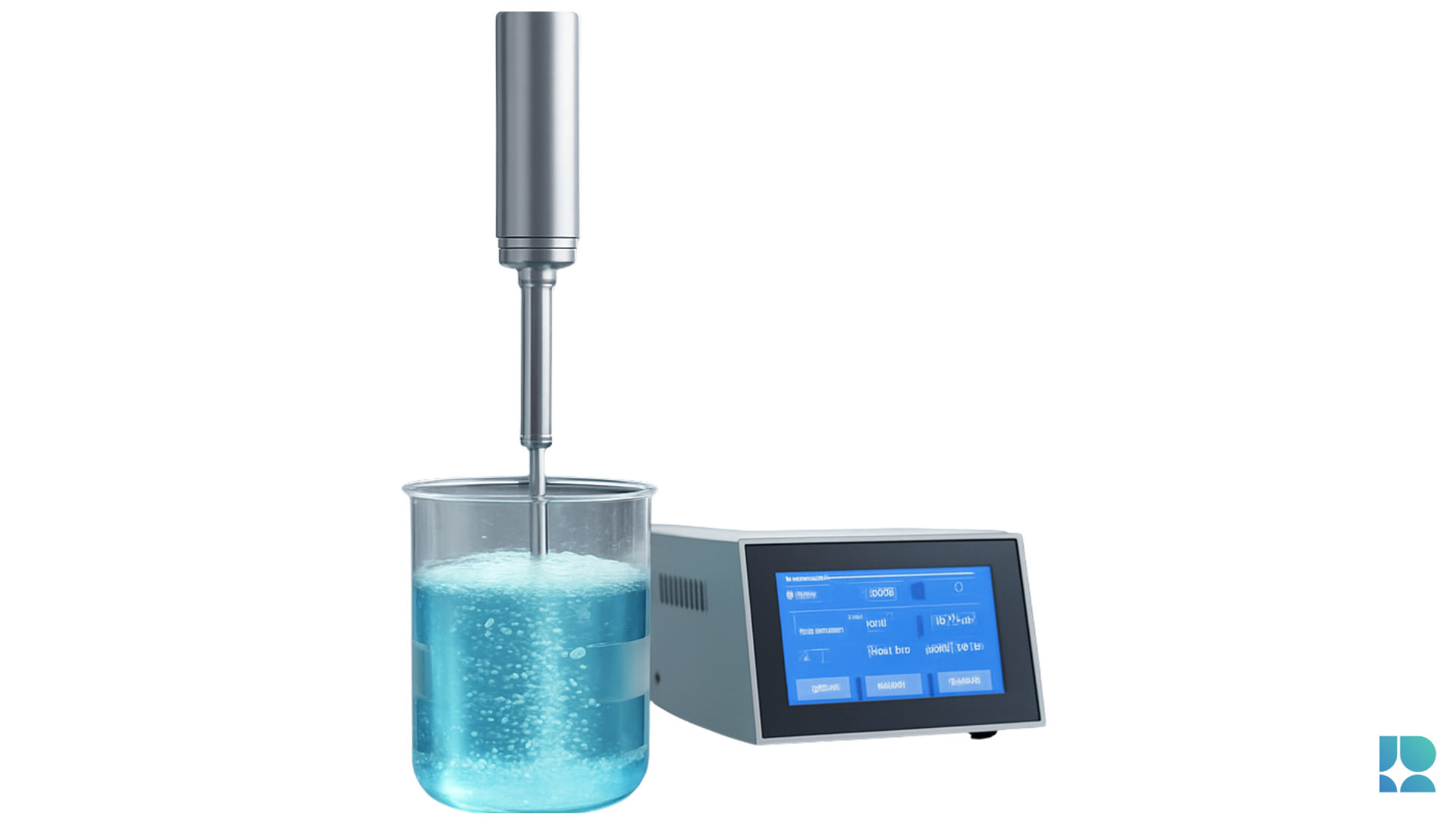
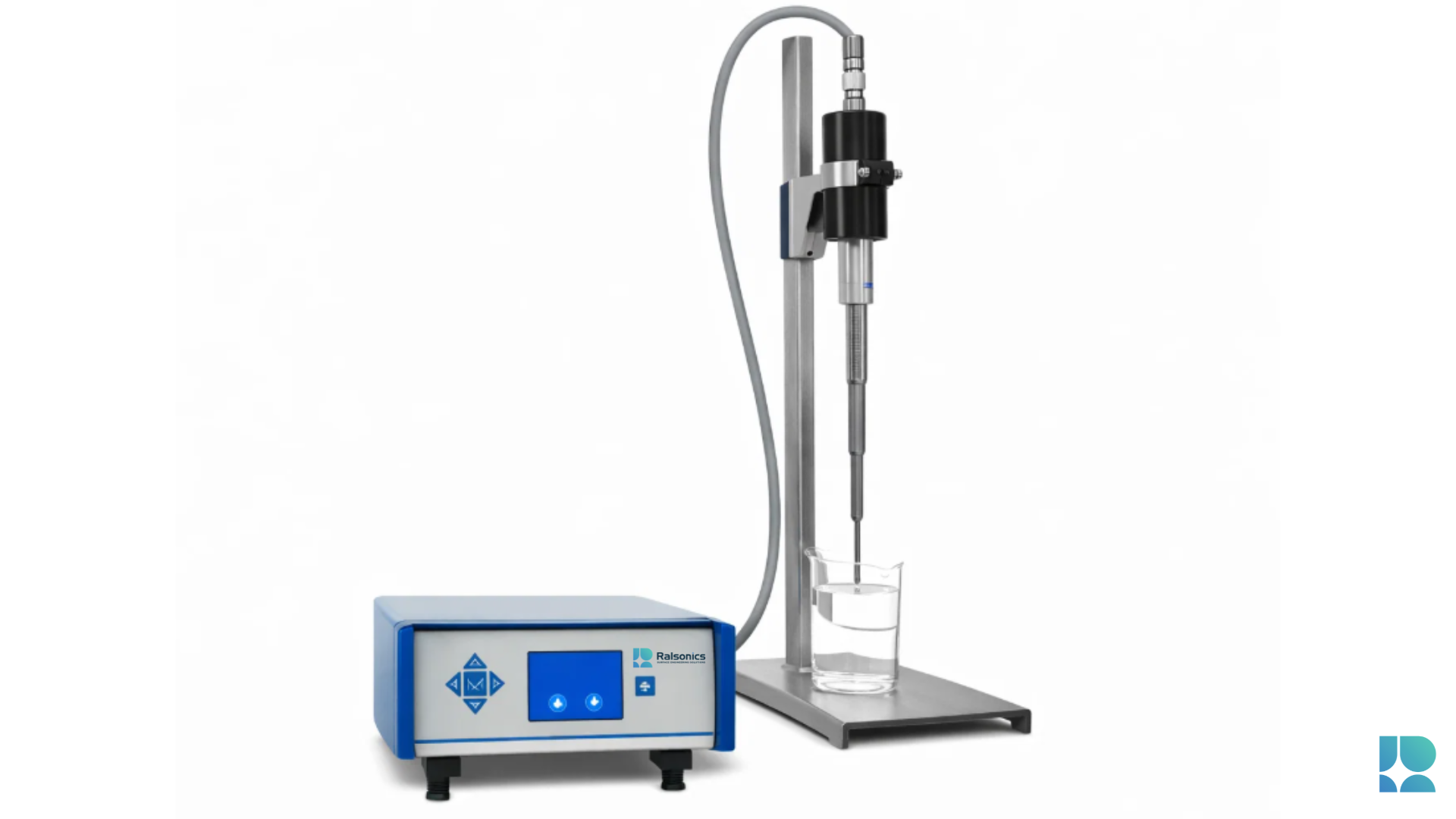


Probe Sonicator
Our Probe Sonicator offers a state-of-the-art solution for precise and efficient ultrasonic processing. Designed for versatility and ease of use, this sonicator is ideal for applications such as homogenization, cell disruption, emulsification, and more. With features like auto-tuning frequency and digital control, it ensures consistent and reliable performance in various scientific and industrial settings.
A Probe Sonicator (also known as a ultrasonic homogenizer or ultrasonic processor) is a powerful ultrasonic device used to disrupt cells, shear DNA, disperse nanoparticles, and homogenize samples. Unlike bath sonicators, a probe sonicator delivers ultrasonic energy directly into the sample through a titanium probe, ensuring high intensity, controlled cavitation, and maximum efficiency.
Ralsonics’ probe sonicators are designed for laboratories, research institutes, pharmaceuticals, nanotechnology, food processing, and biotechnology industries, offering reliable performance with precise control over power, time, and amplitude.
- The probe (horn) vibrates at an ultrasonic frequency (typically 20 kHz – 40 kHz) when powered by the generator.
- This creates intense cavitation in the liquid medium, producing microscopic bubbles that implode and release energy.
- The result is cell disruption, particle dispersion, or homogenization, depending on the application.
- With precise controls, users can adjust pulse mode, amplitude, and duration for reproducible results.
- Direct Energy Delivery – Ultrasonic probe immerses directly into the sample for maximum efficiency.
- Wide Power Range – From compact benchtop units for small samples to high-power models for industrial use.
- Digital Control Panel – Set amplitude, pulse, and run times with ease.
- Programmable Modes – Continuous or pulsed sonication for controlled processing.
- Replaceable Titanium Probes – Available in different sizes for varying sample volumes.
- Temperature Monitoring – Optional integration with chillers to avoid overheating.
- Robust Construction – Long-lasting stainless steel and titanium components.
- Scalable Solutions – Suitable for volumes from a few milliliters to multiple liters.
- High-Intensity Processing: Delivers greater energy density than ultrasonic baths.
- Versatility: Used in biological, chemical, nanomaterial, and industrial applications.
- Precision & Reproducibility: Programmable parameters ensure consistent results.
- Scalable Applications: From laboratory-scale R&D to pilot and industrial processes.
- Efficient Nanoparticle Dispersion: Prevents agglomeration and ensures stable suspensions.
- Enhanced Control: Adjustable amplitude, frequency, and pulse settings.
- Biotechnology: Efficient cell disruption and homogenization for sample preparation.
- Pharmaceuticals: Emulsification and mixing of active ingredients.
- Chemicals: Homogenization and degassing of chemical solutions.
- Food and Beverage: Ensures consistent emulsification and homogenization of ingredients.
- Nanotechnology: Effective dispersion and processing of nanoparticles.
Features and Advantages
Features | Advantage |
|---|---|
High-Frequency Ultrasonic Power | Enables efficient cell disruption, emulsification, and nanoparticle dispersion. |
Adjustable Amplitude Control | Provides precise control over sonication intensity for different sample types. |
Digital Display & Timer | Allows accurate monitoring of process parameters and ensures repeatable results. |
Temperature Control / Probe Cooling | Prevents sample overheating and preserves temperature-sensitive materials. |
Interchangeable Probes (Tips) | Supports different sample volumes and applications with quick probe change. |
Compact & Ergonomic Design | Saves bench space and ensures ease of handling in laboratories. |
Automatic Frequency Tuning | Maintains optimal performance and efficiency during sonication. |
Safety Features (Overload & Overheat Protection) | Protects both the operator and the equipment from damage. |
Stainless Steel Probe Construction | Offers durability and resistance to corrosion and chemical attack. |
Low Noise & Vibration Design | Enhances user comfort and minimizes lab disturbances. |
“FAQs”
A probe sonicator delivers direct, high-intensity energy into the sample, while a bath sonicator provides gentler, uniform cleaning or mixing across multiple samples.
Yes. With different probe sizes, they can process microliters to tens of liters.
Sonication can generate heat, but pulse mode and chillers help prevent damage to heat-sensitive samples.
Probe size depends on sample volume, viscosity, and application. Ralsonics experts provide guidance for proper selection.