

What the Union Budget 2026-27 actually means for component manufacturers on the ground
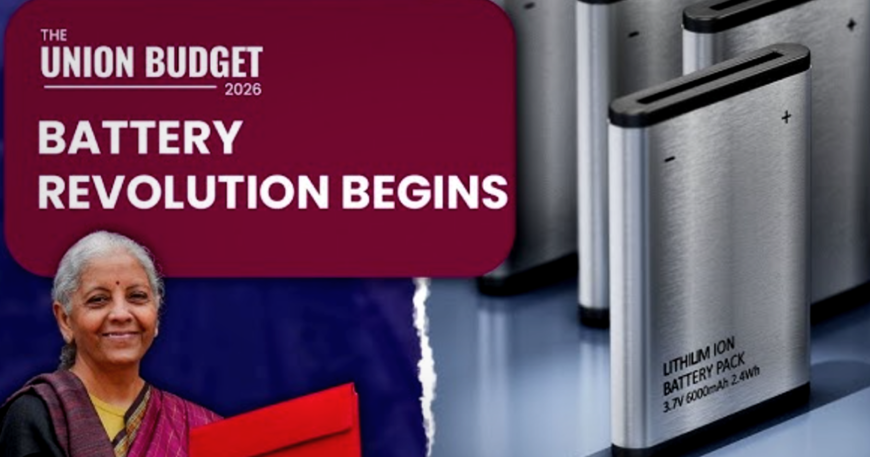
The Union Budget 2026-27 just made it meaningfully cheaper to set up lithium-ion cell manufacturing in India. Customs duty exemptions on capital goods, clearer localisation incentives, and sustained PLI support, the policy signal is unambiguous.
India is building its battery manufacturing backbone right now, not in five years.
For component manufacturers, tier-2 suppliers, and precision engineering companies, this is not background noise. This is the qualification window.
OEMs commissioning gigafactories are simultaneously building their supplier lists. The companies that demonstrate manufacturing readiness today, validated processes, traceable quality systems, repeatable output, are the ones that will be on those lists. The ones that wait until the orders come will spend the next two years trying to catch up.
So what does manufacturing readiness actually look like in a battery-grade supply chain?
The localisation opportunity is real and so is the quality bar
India’s battery manufacturing market is projected to grow at over 23% annually through 2030. Ola Electric, Amara Raja, Exide Energy, and Tata Agratas are all scaling cell and pack assembly capacity. The domestic content requirements built into PLI disbursements mean these companies need Indian suppliers for busbars, cooling plates, motor housings, battery trays, current collectors.
The opportunity is genuine. But so is the quality bar these programmes demand.
Battery-grade components operate at contamination tolerances that most Indian industrial facilities have not previously had to meet. Residual machining oils, metallic fines, and particulate matter that would be invisible and irrelevant on a conventional automotive part become failure points on a battery assembly. A contaminated busbar connection affects cell resistance. A particle on a separator membrane affects safety.
The global standard for cleanliness in battery component manufacturing sits below 5 milligrams of residue per square metre. Meeting that standard consistently, not occasionally, consistently — requires a cleaning infrastructure that is built for the purpose.
What the manufacturers getting qualified are doing differently
The suppliers successfully entering EV and battery supply chains are not doing anything exotic. They are treating surface preparation as a production stage rather than a finishing step. They are installing validated, multistage cleaning systems with documented process parameters. They are generating the cleanliness data that OEM audits require.
Multistage ultrasonic cleaning handles what spray washers and immersion tanks cannot — sub-micron particulate removal from the blind holes, threads, and internal geometries that machined battery components typically have. IoT-enabled monitoring creates the process traceability that quality audits demand. Automated handling eliminates recontamination between stages.
This is not complicated infrastructure. But it needs to be in place before the audit, not after.
The window is open, not permanent
Supplier qualification cycles in automotive and battery manufacturing typically run six to eighteen months. The gigafactories being commissioned now will lock in their tier-1 and tier-2 supplier bases over the next twelve to twenty-four months. After that, breaking in becomes significantly harder.
The budget signal, the gigafactory pipeline, and the localisation mandates are all pointing in the same direction. The manufacturers who read that signal clearly and build their quality infrastructure now are the ones who will be inside those supply chains when full production begins.
Ralsonicsworks with component manufacturers at the qualification stage, helping build the cleaning infrastructure, process documentation, and cleanliness validation that EV OEM audits require.
If you are preparing for supplier qualification or want to understand what battery-grade cleanliness standards mean for your current production line, we would welcome the conversation.
