Demineralization (DM) Plant
A Demineralization (DM) Plant is a proven water treatment system designed to remove dissolved salts, minerals, and impurities through ion exchange technology. DM plants produce high-purity water that is essential for applications requiring low conductivity and mineral-free water, such as boilers, pharmaceuticals, laboratories, and power plants.
Ralsonics offers custom-engineered DM Plants with advanced ion-exchange resins, robust construction, and user-friendly operation, ensuring consistent and reliable performance.
A typical DM plant operates using ion exchange resins that replace dissolved ions with hydrogen (H⁺) and hydroxide (OH⁻) ions, which then combine to form pure water. The process involves:
- Cation Exchange – Removes positively charged ions (Ca²⁺, Mg²⁺, Na⁺, Fe²⁺) and replaces them with H⁺ ions.
- Anion Exchange – Removes negatively charged ions (Cl⁻, SO₄²⁻, NO₃⁻, HCO₃⁻) and replaces them with OH⁻ ions.
- Mixed Bed Polishing (optional) – Provides ultra-pure water by further reducing conductivity and silica.
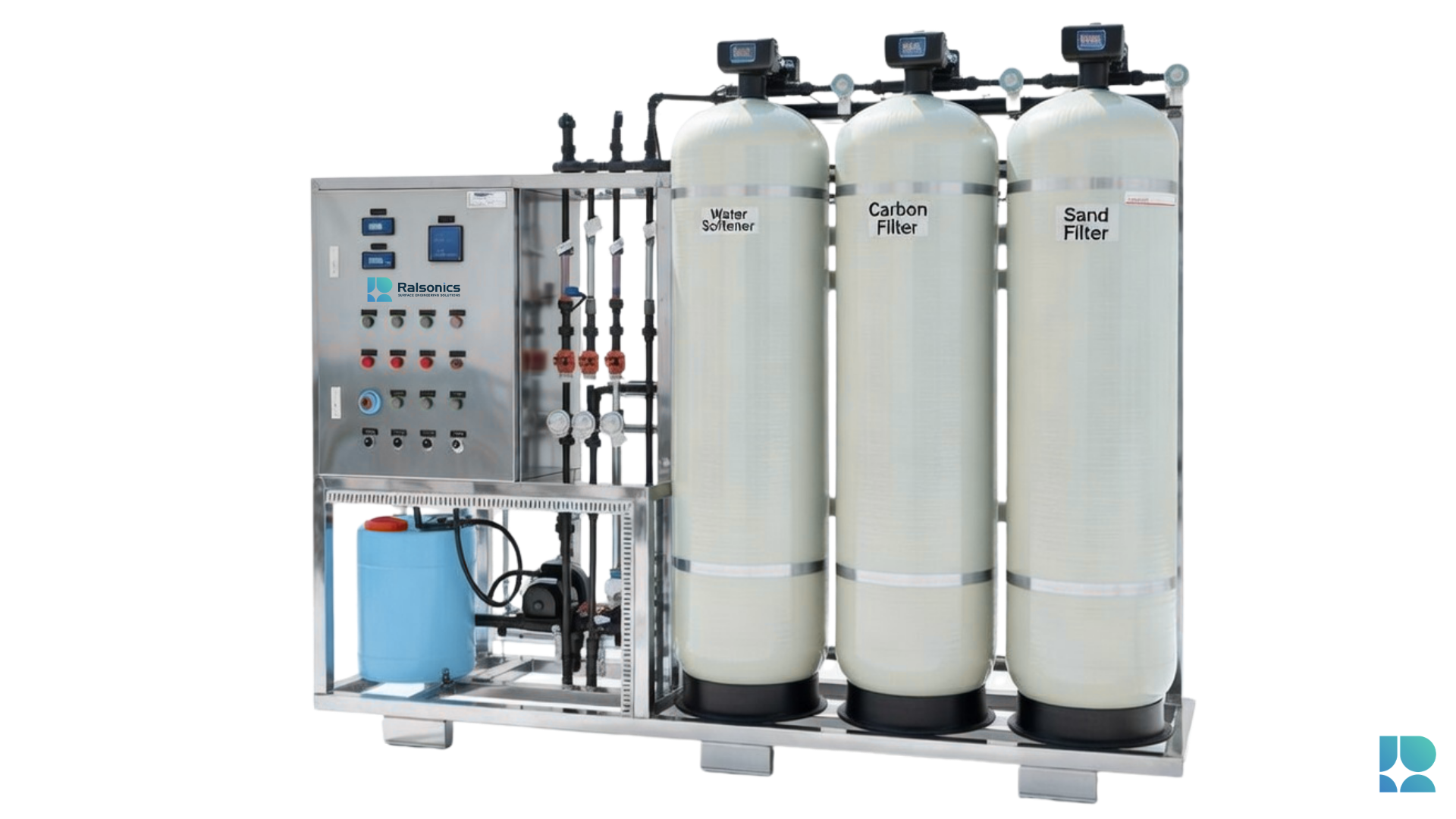
- High-Capacity Ion Exchange Resins – Long life and superior performance.
- Skid-Mounted Compact Design – Easy installation and mobility.
- Automatic or Manual Operation – Options to suit different applications.
- Low Conductivity Output – Achieves conductivity as low as 0.1 µS/cm.
- Corrosion-Resistant Construction – SS/FRP/MSRL vessels available.
- Regeneration System – Efficient acid/alkali regeneration for long-term usage.
- User-Friendly Design – Simple controls and minimal operator training required.
- Customizable Flow Rates – From small laboratories to large industrial plants.
- Consistent High-Purity Water – Removes dissolved salts and minerals effectively.
- Cost-Effective – Lower capital cost compared to RO for low TDS feed water.
- High Efficiency – Produces water suitable for critical industrial applications.
- Scalable Solutions – Available in small, medium, and large capacities.
- Durable & Reliable – Long resin life and robust plant design.
- Flexible Operation – Choice of manual, semi-automatic, or fully automatic controls.
- Power Plants – Boiler feed water and turbine operation.
- Pharmaceuticals – High-purity water for formulations and cleaning.
- Electronics & Semiconductor – Ultra-pure water for sensitive processes.
- Laboratories & Research Institutes – Water for testing and analysis.
- Chemical & Fertilizer Plants – Process water with low ionic content.
- Food & Beverage Industry – Ingredient water and process water.
Technical Specifications
Parameter | Specification |
|---|---|
Flow Rate | 100 LPH – 50,000+ LPH |
Conductivity of Output | ≤ 0.1 – 1 µS/cm |
pH of Treated Water | Neutral (6.5 – 7.5) |
Material of Construction | FRP / MSRL / SS 304 / SS 316 |
Resin Type | Strong Acid Cation (SAC), Strong Base Anion (SBA), Mixed Bed (MB) |
Operation | Manual / Semi-Automatic / PLC-SCADA |
Recovery Rate | 40% – 70% (customizable) |
Regeneration | Acid (HCl/H₂SO₄) & Alkali (NaOH) |
Optional Add-ons | Degasser, Activated Carbon Filter, Mixed Bed Polisher |
FAQ
- RO plants use membranes to remove salts, while DM plants use ion exchange resins.
- RO is ideal for high TDS feed water, while DM is best for low to medium TDS water.
Regeneration frequency depends on feed water quality and plant capacity but typically occurs after 8–12 hours of operation.
Resins generally last 3–5 years with proper regeneration and maintenance.
Yes, especially when a Mixed Bed Polisher is included, silica and trace ions are removed effectively.
Yes, but it requires acid and alkali for regeneration, so proper handling and neutralization systems must be used.