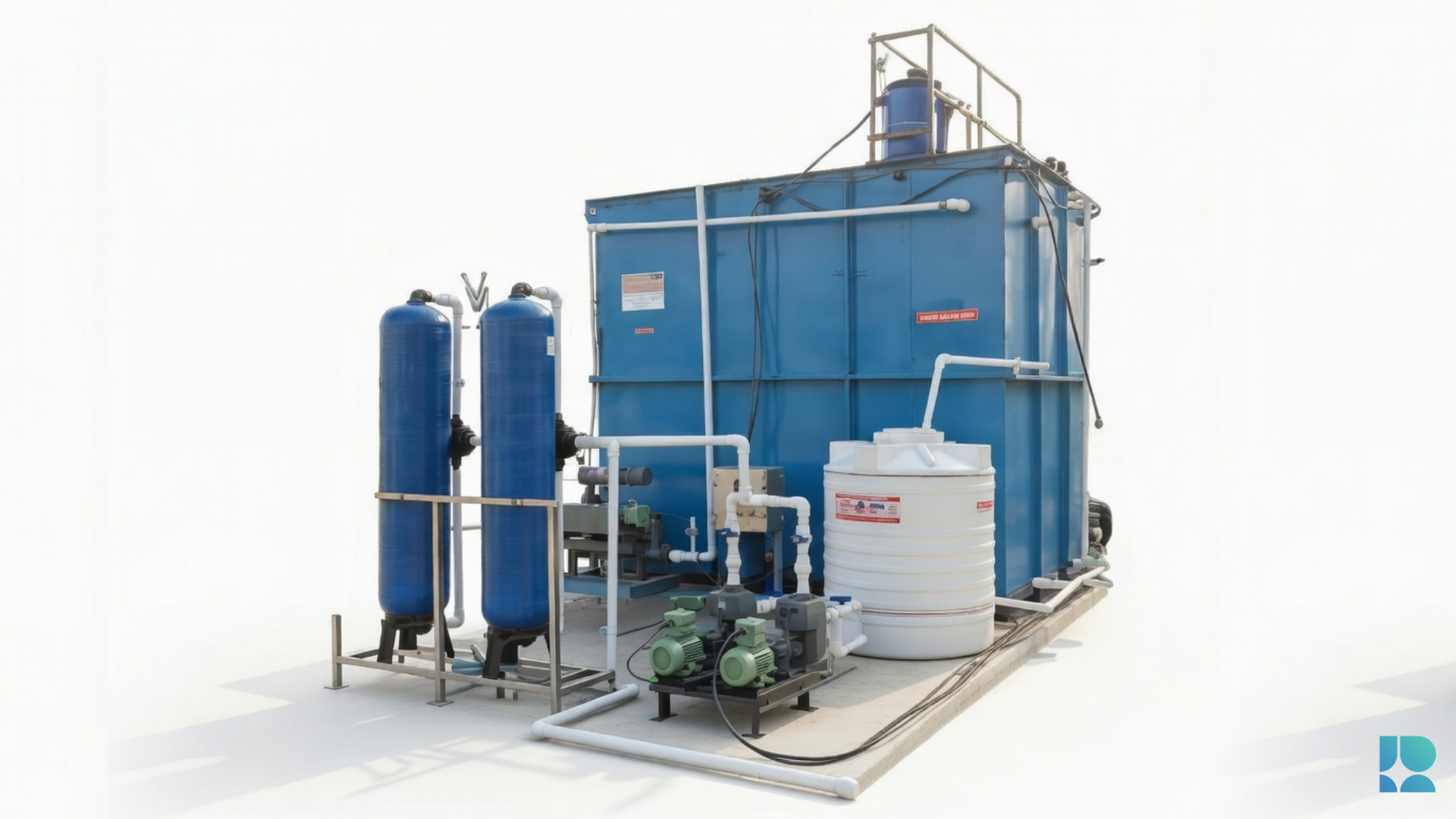
A Deionization (DI) Plant is a water purification system that removes dissolved salts, minerals, and ionic impurities through ion exchange technology. Unlike conventional filtration, DI plants produce ultra-pure water with very low conductivity, making them essential in industries where high-purity process water is required, such as electronics, pharmaceuticals, laboratories, and power generation.
Ralsonics DI Plants are designed with advanced ion exchange resins, robust construction, and intelligent controls to deliver consistent and reliable deionized water for industrial and institutional needs.
How a DI Plant Works
Deionization works on the principle of ion exchange:
H⁺ and OH⁻ combine to form pure H₂O, free of dissolved salts and minerals.
Optional Mixed Bed Units – Provide polishing for ultra-pure water (conductivity ≤ 0.1 µS/cm).
Types of DI Plants
Two-Bed Deionizer
Separate cation and anion exchange vessels.
Produces water with conductivity between 5–30 µS/cm.
Suitable for general industrial and laboratory applications.
Mixed Bed Deionizer
Contains both cation and anion resins in a single vessel.
Produces ultra-pure water (≤ 0.1–1 µS/cm).
Ideal for electronics, pharmaceuticals, and medical industries.
Continuous Electro-Deionization (CEDI)
Combines ion exchange resins with an electrical current.
Provides continuous deionized water without frequent chemical regeneration.
Best suited for high-purity, high-volume industrial processes.
Automatic / Manual DI Plants
Automatic: PLC/SCADA-controlled systems for continuous monitoring and regeneration.
Manual: Cost-effective systems for small-scale or batch operations.
Key Features of Ralsonics’ DM Plants
High-Capacity Ion Exchange Resins – Ensures long operating cycles.
Ultra-Pure Output – Conductivity as low as 0.1 µS/cm.
Skid-Mounted Compact Design – Easy to install and relocate.
Corrosion-Resistant Construction – FRP, MSRL, or stainless steel vessels.
Automatic or Manual Controls – Flexibility for different user needs.
Optional CEDI Technology – Eliminates need for acid/alkali regeneration.
Low Operating Cost – Efficient design with minimal chemical use.
Customizable Flow Rates – From small laboratories to large industries.
Advantage
High-Purity Water – Ideal for applications requiring low conductivity and silica-free water.
Eco-Friendly Option (CEDI) – Reduces or eliminates chemical regeneration.
Reliable & Consistent – Produces stable water quality regardless of variations in feed water.
Scalable – From laboratory units to large industrial plants.
Durable Design – Long service life of resins and vessels.
Flexible Solutions – Available in two-bed, mixed bed, and CEDI systems.
Industry Applications
Pharmaceuticals – High-purity water for formulations and sterile cleaning.
Electronics & Semiconductor – Ultra-pure water for wafer and chip manufacturing.
Power Plants – Boiler feed water and turbine systems.
Laboratories – Analytical, testing, and research applications.
Food & Beverage – Ingredient and process water requiring low conductivity.
Medical & Healthcare – Water for dialysis and sterilization processes.
Technical Specifications
Parameter
Specification
Flow Rate
100 LPH – 50,000+ LPH
Conductivity of Output
≤ 0.1 – 5 µS/cm
pH of Treated Water
Neutral (6.5 – 7.5)
Material of Construction
FRP / MSRL / SS 304 / SS 316
Resin Type
Strong Acid Cation (SAC), Strong Base Anion (SBA), Mixed Bed (MB)
Operation
Manual / Semi-Automatic / PLC-SCADA
Regeneration
Acid (HCl/H₂SO₄) & Alkali (NaOH) / CEDI (no regeneration)
Optional Add-ons
UV Disinfection, Ozone Treatment, Mixed Bed Polisher
FAQ
How is DI different from DM?
Both use ion exchange, but DI plants are optimized for ultra-pure water (very low conductivity), while DM plants are designed for general demineralization.
What is the lifespan of DI resins?
Resins typically last 3–5 years, depending on feed water quality and regeneration practices.
Is regeneration required in DI plants?
Two-Bed & Mixed Bed DI Plants – Require periodic regeneration using acids and alkalis.
CEDI Plants – Do not require chemical regeneration.
Can DI water be used for drinking?
No, DI water is not recommended for drinking as it lacks essential minerals. It is used only for industrial and scientific purposes.